
Introduction
The Family Laboratories – Light Instruments marked a new stage in the development of Pilot 2, focusing on the exploration of the first Light Instruments prototypes within an artistic laboratory setting.
Throughout this cycle, four individual laboratories and one group laboratory were conducted, providing the opportunity to explore how babies and young children interacted with the light instruments and to evaluate their integration into the artistic experience.
The primary aim of this phase was to understand how the Light Instruments were explored by the children, identify opportunities for both artistic and technological improvement, and gather feedback from families and the multidisciplinary team to support the ongoing development of the prototypes.
As in previous laboratories, the process combined artistic experimentation, participant observation and collaborative reflection involving artists, technologists, families and the wider project team, maintaining the Human-Centred approach as the guiding principle throughout the development process.

Objectives
The main objectives of this cycle of laboratories were to:
Explore how babies and young children interacted with the first Light Instruments prototypes.
Observe how children used and attributed meaning to the instruments within an artistic setting.
Evaluate the integration of the light instruments into the artistic experience, particularly the relationship between movement, light and creative expression.
Identify opportunities to improve the robustness, safety, ergonomics and functionality of the prototypes.
Gather feedback from families and the multidisciplinary team to inform the iterative development of the Light Instruments and the remaining technological solutions within Pilot 2.

Location
Musicalmente
Rua da Saudade, 20
2410-241 Pousos – Leiria, Portugal
26 July 2026
Five laboratories were conducted throughout the day:
Laboratory 1: 10:00 – 10:30 CET
Laboratory 2: 10:30 – 11:00 CET
Laboratory 3: 11:00 – 11:30 CET
Laboratory 4: 11:30 – 12:00 CET
Reflection sessions with the multidisciplinary team
Laboratory 5: 15:30 – 16:15 CET
Family feedback and reflection session
Final multidisciplinary reflection session
At the end of each laboratory, families were invited to take part in a brief feedback discussion, allowing the team to gather their immediate reflections on the experience. A QR code linking to a questionnaire developed by the Human-Centred team was also made available to collect additional feedback regarding the Light Instruments and the overall laboratory experience.
Following the four individual laboratories, the multidisciplinary team held a reflection session to review the observations gathered throughout the morning. A second evaluation meeting took place after the group laboratory, bringing together the observations collected across the entire day.
Participants
The laboratories involved a total of 31 participants, including children, accompanying family members and the multidisciplinary team of Pilot 2.
Families, Babies and Children
- 10 babies and children
- 14 accompanying family members
Artistic Team
- Paulo Lameiro – Artistic Director
- José Lopes – Musician
- Cristiana Lameiro – Musician
- Inesa Markava – Dancer
Production and Technical Support
- Gil Jerónimo – Production
- Thomas Roggla – Technologist
Human-Centred Approach
- Lara Matos – Psychologist and Human-Centred Approach Facilitator
Session facilitators
The sessions were facilitated by a team with complementary responsibilities in artistic coordination, Human-Centred mediation and support for families.
Session Coordination: Paulo Lameiro
Process Mediation (Human-Centred): Lara Matos
Support for Session Facilitation and Family Mediation: Cristiana Lameiro

Materials and Logistics
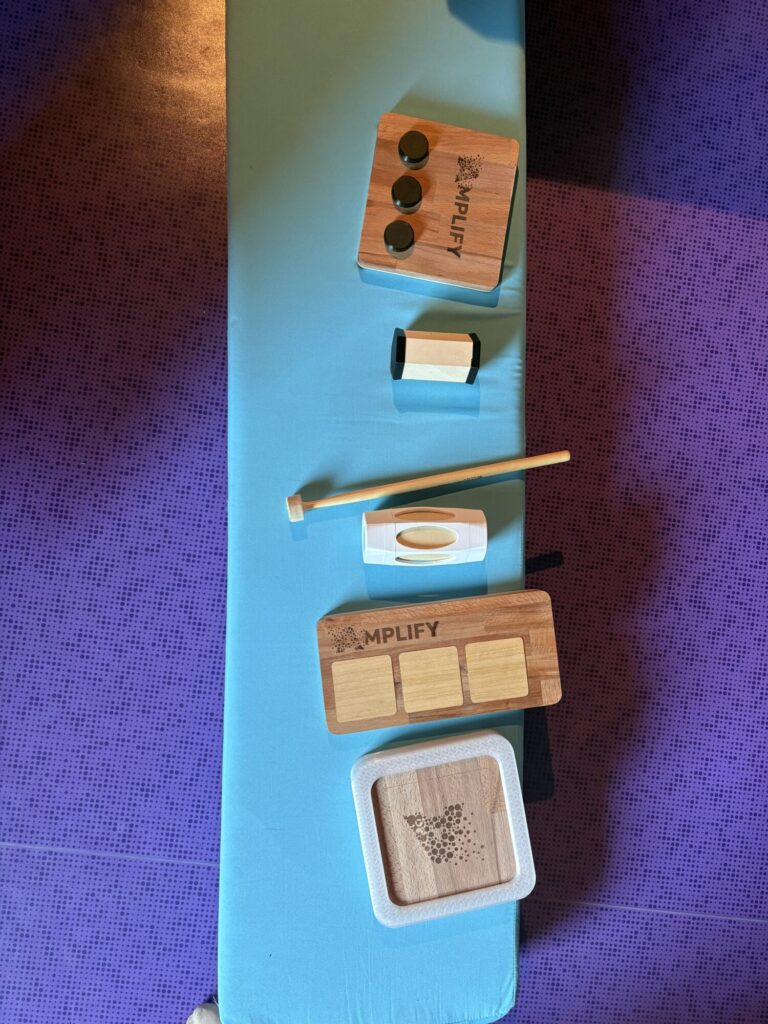
The laboratories used the first functional prototypes of the Light Instruments, developed to explore the relationship between movement and light response during the artistic experience.
The following were also used:
- an experimental costume prototype incorporating LED strips;
- physiological sensors used for data collection;
- augmented reality glasses (XR);
- cameras for video recording and engagement monitoring;
- computers and software supporting the operation of the different technological systems;
- lighting systems and the remaining technical equipment required for the sessions.
The hygiene and protection procedures adopted in previous laboratories were maintained, including the cleaning and disinfection of equipment between sessions and the individual preparation of materials used by the families.
Methodological approach
The methodology followed the structure adopted in previous laboratories, combining artistic experimentation, participant observation and multidisciplinary reflection.
The laboratories were conceived as experimental settings in which artists, technologists, families and researchers jointly participated in the evaluation of the Light Instruments, making it possible to observe the spontaneous use of the prototypes by children in an artistic context.
Information was gathered from different sources, including direct observation, family feedback, reflection sessions with the team and data from the technological systems. Bringing these different perspectives together made it possible to understand not only the technical functioning of the prototypes, but also how they were appropriated by the children during the experience.
The learning resulting from this set of laboratories formed the basis for identifying opportunities for improvement and defining the next stages in the development of the Light Instruments and the remaining technological solutions of Pilot 2.
Session
The laboratories were organised into two distinct moments, allowing the use of the Light Instruments to be observed in different participation settings.
Individual Laboratories
During the morning, four individual laboratories were conducted, with one family participating in each session.
The space was prepared to resemble the conditions of a Concerts for
Babies performance, including the organisation of the environment, the arrangement of the materials, the lighting and the presence of the artistic team.
Each session included:
- welcoming the family;
- fitting the physiological sensors;
- an artistic experience using the Light Instruments;
- participant observation carried out by the team;
- a brief feedback and sharing session at the end of the laboratory.
Following the four individual laboratories, a multidisciplinary reflection session was held, bringing together artists, technologists and the remaining Pilot 2 team members to discuss the main observations and identify aspects to be developed in the following sessions.
Group Laboratory
During the afternoon, a group laboratory was held with the participation of four children accompanied by their families.
This format made it possible to observe the simultaneous use of the Light Instruments by several children, exploring different forms of interaction between participants, artists and technology.
As in the individual laboratories, the session included:
- welcoming the families;
- fitting the physiological sensors;
- the artistic experience;
- participant observation;
- a final feedback and sharing session with the families, including an informal discussion and a questionnaire accessed via QR code.
At the end of the session, a further multidisciplinary reflection meeting was held, integrating the observations collected throughout the day and identifying the main directions for the continued development of the Light Instruments.

Reflections and Discussion
Children’s Interaction with the Light Instruments
The laboratories consistently demonstrated that the Light Instruments aroused curiosity, interest and a willingness to explore among the children. In both the individual and group sessions, children approached the instruments spontaneously, respecting their own pace and without requiring direct guidance from adults.
During the individual laboratories, it was observed that some children required a short period of adaptation before beginning to explore the objects. Following this initial moment, interaction developed naturally,
characterised by curiosity, contemplation and free exploration.
In the group laboratory, exploration became more dynamic and social. Children exchanged instruments, observed each other’s actions, vocalised, sang and spontaneously reproduced sound patterns, demonstrating a higher level of initiative and interaction with one another.
The observations suggest that the children’s main interest lay in the physical and sensory exploration of the objects, privileging movement, manipulation and the discovery of their different possibilities for use.
Relationship between Movement and Light
One of the main questions explored during this cycle of laboratories was how children established a relationship between their movements and the light response produced by the experimental costume.
In the individual laboratories, using one instrument at a time enabled a clearer association between each object and its corresponding light pattern. However, it was observed that children focused primarily on exploring the instrument itself, directing their attention towards the object they were manipulating rather than towards the light response produced on the performer’s costume.
In the group laboratory, the simultaneous use of several instruments made this visual relationship less evident. The activation of different light patterns at the same time made it more difficult to identify the correspondence between each instrument and its respective light response.
Some technical limitations were also identified, namely unintended activations caused by vibrations from nearby musical instruments, inconsistent light responses and a slight delay in LED activation. Despite these limitations, the observations suggest that the light response functions primarily as a complementary dimension of the artistic experience, and that it is not necessary for children to explicitly understand the relationship between movement and light for the experience to remain meaningful.
Development of the Light Instruments
This cycle of laboratories provided an important opportunity to identify improvements to be introduced into the Light Instruments. The children’s spontaneous exploration revealed aspects related to the robustness, safety, ergonomics and sensitivity of the prototypes. In some cases, children dismantled components, removed buttons and managed to access the battery compartment, highlighting the need to reinforce the protection of the different elements and improve the structural durability of the prototypes.
The observations also reinforced the idea that these objects do not
need to replicate traditional musical instruments. On the contrary, they appear to be more readily appropriated by children when they assume their own identity as objects for artistic exploration, valuing shape, texture, movement and sensory experience.
Further opportunities for improvement were identified regarding the size of some prototypes, the diversity of materials and textures, the ergonomics of the objects and the sensitivity of the sensors, allowing for a more consistent response to the different forms of manipulation observed during the laboratories.
Technological Integration
The laboratories also provided an opportunity to evaluate the performance of the different technological systems developed within Pilot 2.
Overall, the integration between the Light Instruments, the experimental costume and the remaining technological systems proved to be functional, making it possible to validate the artistic concept underlying this stage of the project.
However, a significant difference was observed between the automatic engagement indicators generated by the software and the observations made by the team. On several occasions, the technological systems indicated low levels of engagement, while children and families demonstrated high levels of attention, curiosity and involvement.
This discrepancy reinforced the importance of continuing to develop and calibrate the automatic monitoring systems, while recognising the value of participant observation as an essential complement to the interpretation of technological data.
Families’ and Team Reflections
Families actively contributed to the reflection on the experience, providing suggestions regarding the Light Instruments, the materials used and the artistic experience.
Among the main contributions was the suggestion to incorporate different textures, reinforce the robustness of the instruments and improve the ergonomics of the sleeves used for the physiological sensors. Questions were also raised about whether the use of the instruments should be demonstrated beforehand or whether a child-centred approach based on spontaneous exploration should be maintained.
The reflection meetings held with the artists, technologists and the remaining team members made it possible to integrate these observations into the project’s ongoing development. In addition to the technical improvements identified, the discussions reinforced the importance of maintaining an iterative approach, in which each cycle of
laboratories directly informs the subsequent artistic and technological development.
This process once again confirmed that the evolution of the Light Instruments results from the combination of participant observation, family feedback, artistic experience and technological development, while maintaining the Human-Centred approach as a fundamental element of Pilot 2.

Next Steps
The results obtained during the laboratories made it possible to identify a number of priorities for the next stages of Pilot 2.
The main actions include:
- Reinforcing the robustness and safety of the Light Instruments, ensuring greater resistance to children’s spontaneous exploration.
- Improving the ergonomics of the prototypes by exploring new shapes, materials and textures better suited to different age groups.
- Adjusting the sensitivity of the sensors to reduce unintended activations and provide a more consistent light response.
- Continuing the development of the illuminated costumes, promoting a clearer integration between movement, light and the artistic experience.
- Further improving the engagement monitoring systems in order to achieve greater correspondence between the technological indicators and participant observation.
- Developing more comfortable and adjustable sleeves for the physiological sensors.
- Continuing the iterative co-design process by involving children, families, artists, technologists and researchers in the ongoing development of the different prototypes.
Conclusion
The laboratories represented an important stage in the development of Pilot 2, providing the first opportunity to test the Light Instruments in an artistic setting with babies, young children and their families.
This cycle of laboratories enabled a deeper understanding of how children explore the light instruments and identified key aspects for their artistic and technological development. The observations showed that spontaneous exploration, curiosity and sensory experience played a more significant role than an explicit understanding of the relationship between movement and light response.
The results also contributed to guiding the development of the prototypes by identifying improvements related to robustness, safety, ergonomics, sensor sensitivity and the integration of the different technological systems.
The involvement of families, artists, technologists and the wider team once again demonstrated the value of the Human-Centred approach, in which technological development emerges from observation, artistic experience and the active participation of everyone involved.
This cycle of laboratories reinforces the continuity of an iterative development process, in which each new phase of experimentation contributes simultaneously to improving the technology, the artistic experience and the knowledge generated within Pilot 2.


