
1st Family Laboratory
By Lara Matos, CPL
21 February 2026, 16:00 – 17:30 CET at Musicalmente
This Family Laboratory marked the first experimental session involving babies, families, artists and physiological sensors within a live musical environment.
The session was conceived as an exploratory moment to test the practical integration of the sensors during a Concerts for Babies setting. The intention was to observe how the devices could be introduced, used and managed in a real situation while preserving the quality of interaction, listening and proximity that characterises this artistic format.
Rather than producing validated data, this laboratory aimed to document procedures, reactions, technical behaviour and emerging questions in order to inform the next stages of development.

Objectives
To test the use of sensors with babies in a live session.
To observe comfort, acceptance and integration of the devices within the natural dynamics of the environment.
To experiment with procedures for placing, removing and rotating the sensors among participants.
To verify real-time data transmission and visualisation.
To identify practical, relational and technical challenges arising from their use.
To collect initial impressions from families and the artistic team.
To generate guiding questions for subsequent experimentation and analysis.

Participants
The session involved a total of 32 participants, including babies, family members, artists and support staff.
Families and Babies
- Eight babies accompanied by their families, participating voluntarily in the session.
Artistic Team
- Cristiana, José, Inesa and Isabel – Artists involved in the session
- Paulo Lameiro – Artistic Director
Process Support
- Lara Matos – Psychologist, responsible for mediating the process with families, welcoming participants and accompanying procedures related to the use of the sensors and informed consent.
- Isabel Lucena – Consortium representative, attending the session as an observer of the process and its development.
Documentation
- Pedro – Audiovisual professional responsible for recording material for project documentation.
Materials and Logistics
Materials
- Sensors used to collect physiological data, placed on the babies’ ankles.
- Infant socks used to secure the sensors in a comfortable and familiar way.
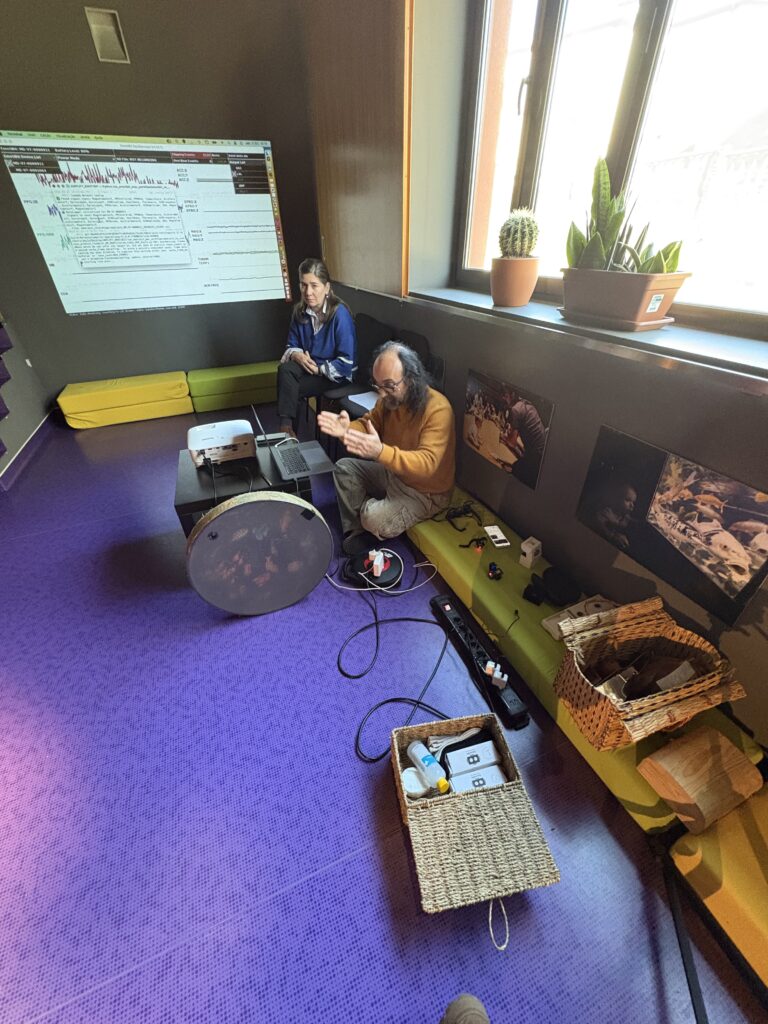
- Computer for receiving data in real time.
- Wall projection displaying live signal visualisation.
- Augmented reality glasses used experimentally by selected artists.
- Hygiene and disinfection kits used between sensor placements.
Logistics
- Small group format to ensure a calm atmosphere and careful handling of the devices.
- Gradual introduction of the sensors with the presence and participation of parents.
- Testing of cleaning and transfer procedures between uses.
- Alternation between the musical flow and moments of technical adjustment.
Session structure
Arrival and welcome
Families were received informally. The first babies to arrive were invited, together with their parents, to a separate room where the sensors were presented and placed in a calm and dialogical manner.
Sensor Introduction
Placement was conducted as a small relational ritual, allowing babies to familiarise themselves with the objects while parents actively collaborated.
Musical Session
The group gathered in the main space, where the musical interaction unfolded with all families present. Babies wearing sensors participated freely alongside the others.
Sensor Rotation
Sensors were transferred between babies throughout the session so that all could experience their use. Two approaches were tested: exchanges carried out in a separate room and exchanges conducted within the shared space, in order to compare their impact on the session flow.
Real-Time Visualisation
Physiological data were projected live, allowing observation of signal variation without attempting interpretation at this stage.
Closing Moment
An informal sharing with families allowed the collection of impressions, reactions and questions.
Reflections and discussion
Families showed openness and curiosity towards the experience. Many expressed surprise at the small scale and simplicity of the sensors, having initially imagined more intrusive equipment.
No signs of discomfort were observed among the babies. Most appeared unaware of wearing the device, and some resisted its removal, suggesting rapid adaptation.
The session confirmed that the introduction of these devices can be carried out without disturbing the atmosphere of the musical encounter when handled gradually and relationally.
At the same time, observing physiological data in real time highlighted the complexity of interpretation within an environment rich in simultaneous stimuli. Babies respond simultaneously to multiple stimuli, including sound, movement, spatial variation, light and proximity. This raised important questions regarding how collected signals may be meaningfully related to aspects of the lived experience.
Technical testing also revealed aspects requiring refinement, including sensor reliability, synchronisation between devices and optimisation of handling procedures.
The informal moments surrounding the session also proved significant for fostering relationships among participants. The presence of a small refreshment for babies and coffee for adults created opportunities for conversation both before and especially after the laboratory, extending the experience beyond the structured activities. Some families brought older siblings or invited friends to attend, share impressions and even try the glasses, contributing to a broader atmosphere of curiosity and collective participation. The fact that certain families travelled from other cities, occasionally bringing small gestures such as sharing food, further reflected the sense of trust, engagement and community generated around the project.

Next steps
- Improve technical stability and multi-sensor functionality.
- Refine procedures for placement and rotation of the devices.
- Develop observation strategies to better contextualise physiological signals.
- Continue small-scale sessions to consolidate working methods.
- Strengthen dialogue between artistic, technological and research perspectives.
Conclusions
This first Family Laboratory provided an essential moment of practical experimentation, allowing the team to test procedures, observe participant responses and identify both technical and conceptual challenges.
The session confirmed the feasibility of integrating these technologies into this context while also revealing the need for careful methodological development in order to understand the significance of the collected signals.
It therefore represents an initial step in an ongoing process of adjustment, learning and interdisciplinary collaboration.


